1st Grade Florida FAST Math Practice
PM Math gives first graders visual, age-appropriate practice with place value, addition and subtraction, telling time, early fractions, and more, with Listen support, step-by-step help, and practice built around Florida B.E.S.T. benchmarks so students build real skills and confidence.
Monthly $7.99 · Annual $79 · Cancel anytime
See how PM Math works
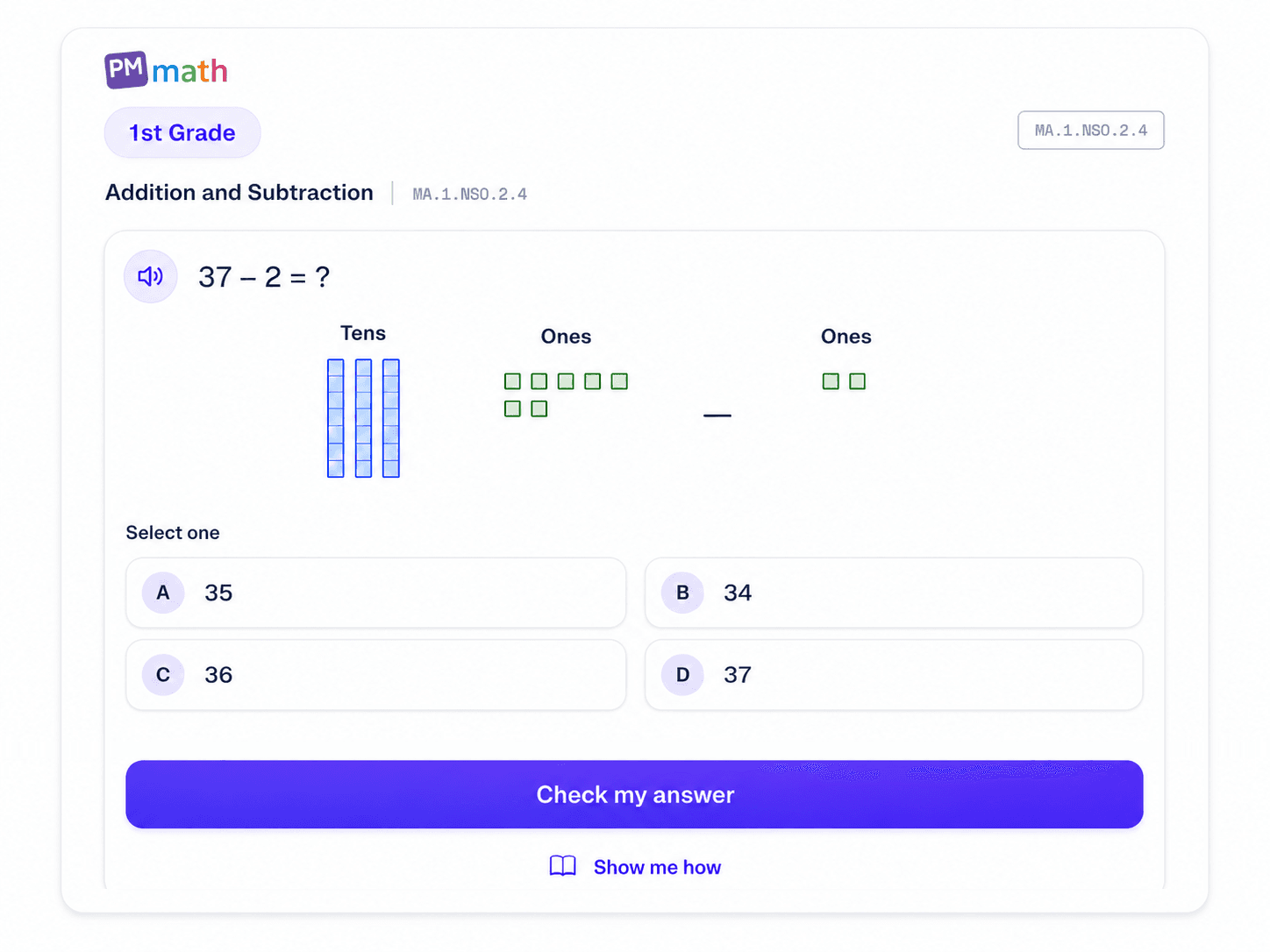
Grade 1 practice uses this same flow: a personalized dashboard, Florida B.E.S.T. benchmarks, practice checks, clear results, and step-by-step walkthroughs.
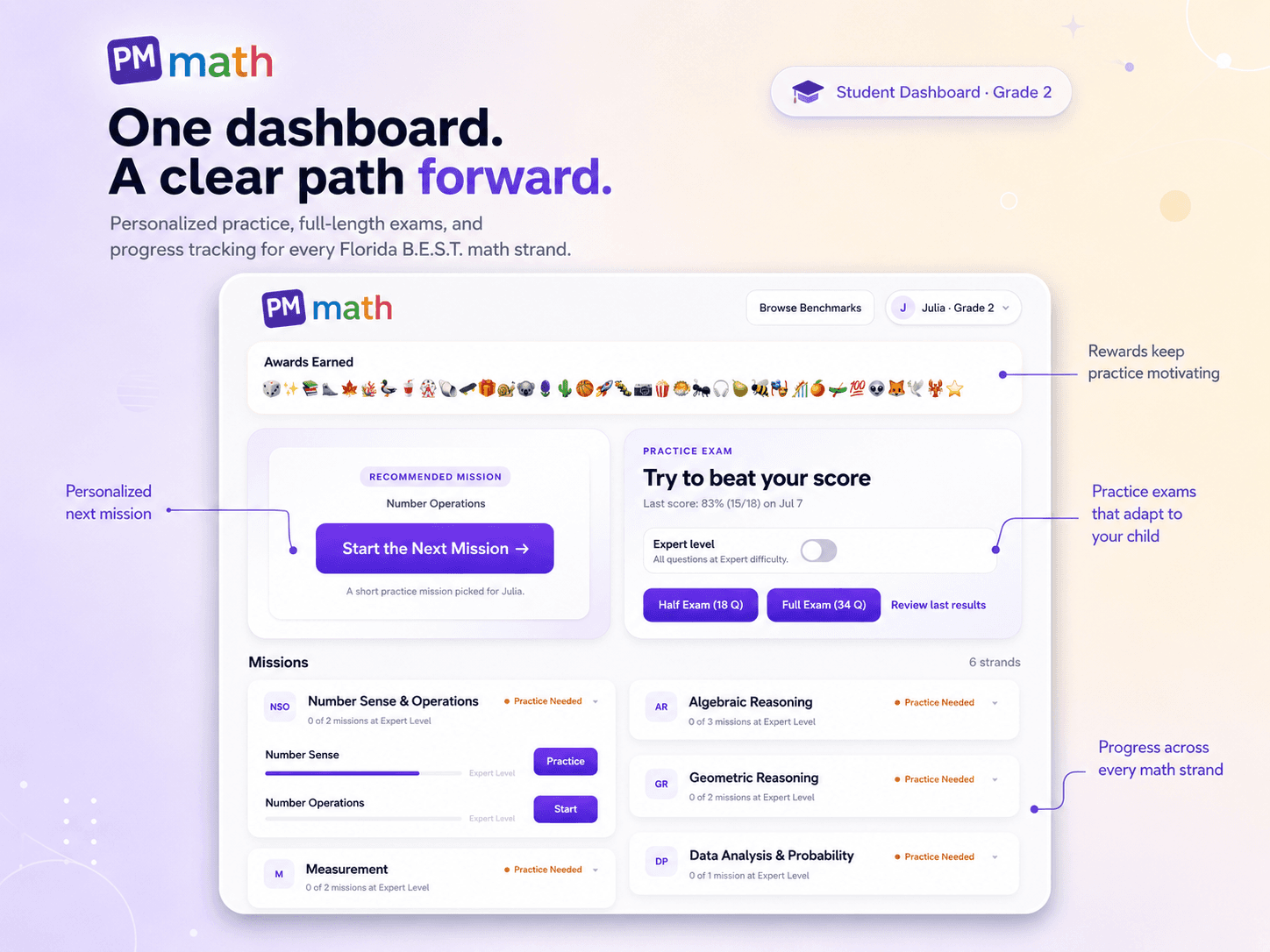
A clear path forward
PM Math recommends the next mission and keeps every math strand organized in one personalized dashboard.
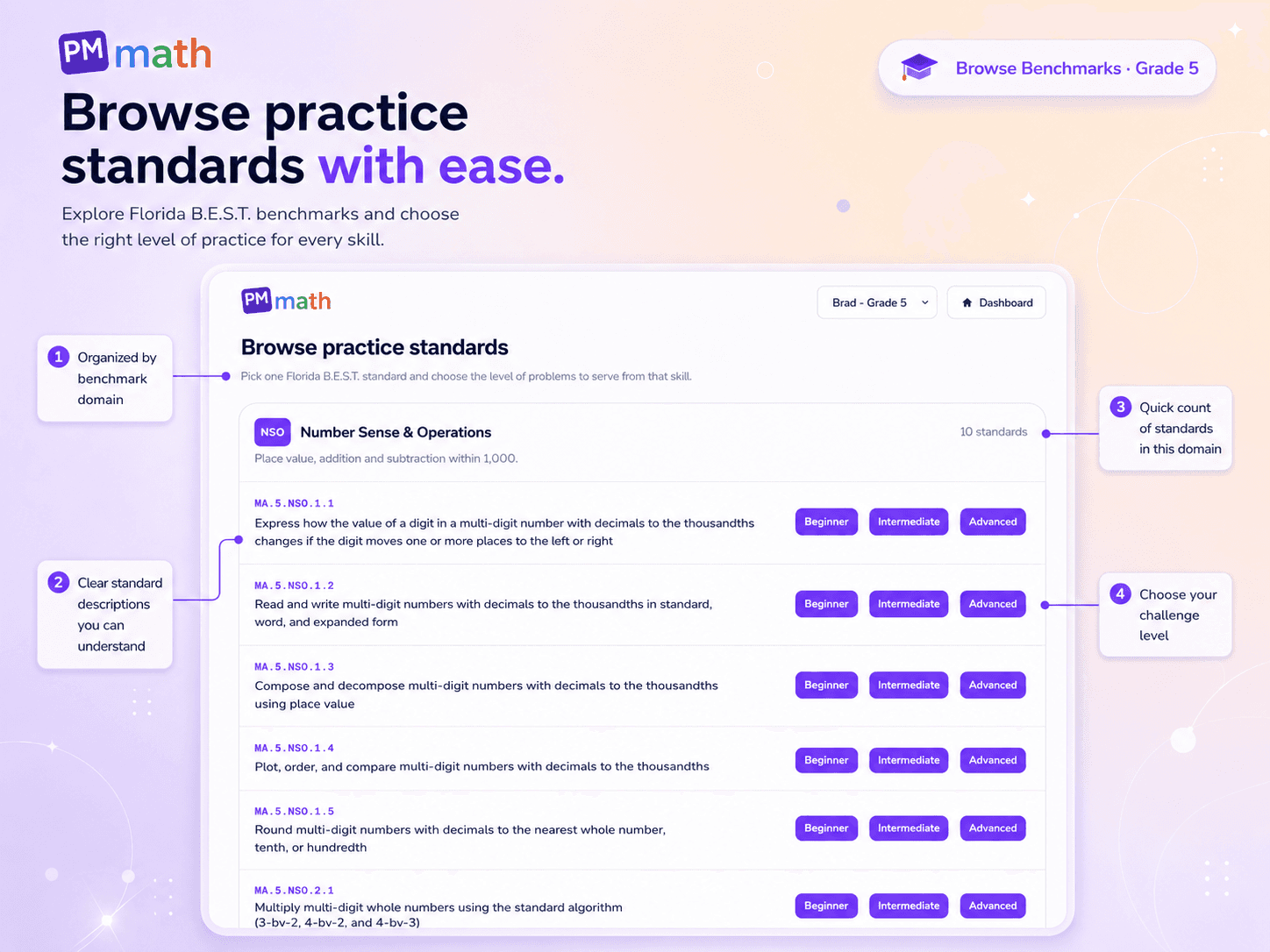
Practice any standard
Explore Florida B.E.S.T. benchmarks and choose Beginner, Intermediate, or Advanced practice for every skill.
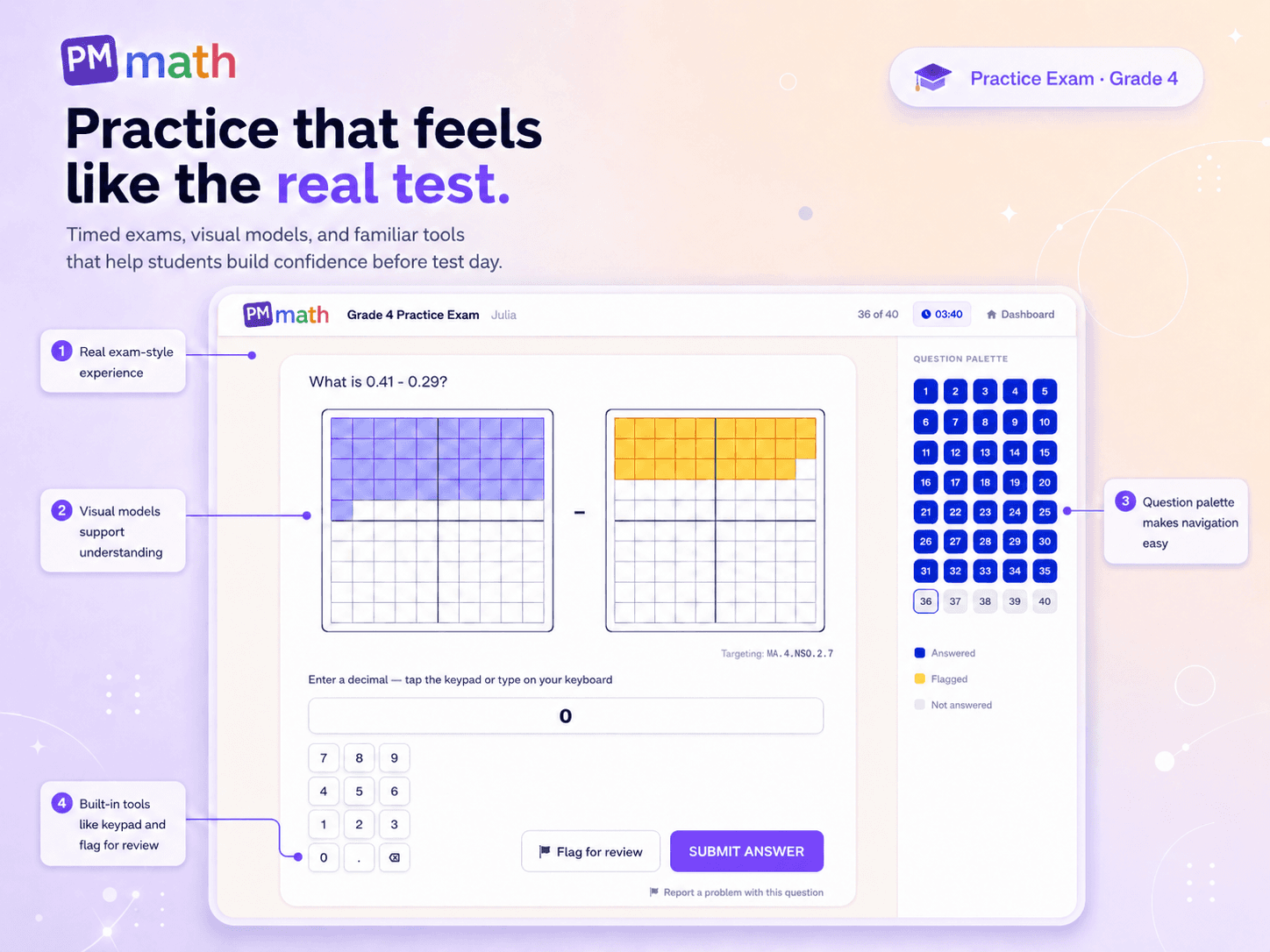
Practice that feels like the real test
Timed practice exams include visual models, familiar navigation, and built-in tools that help students feel prepared.
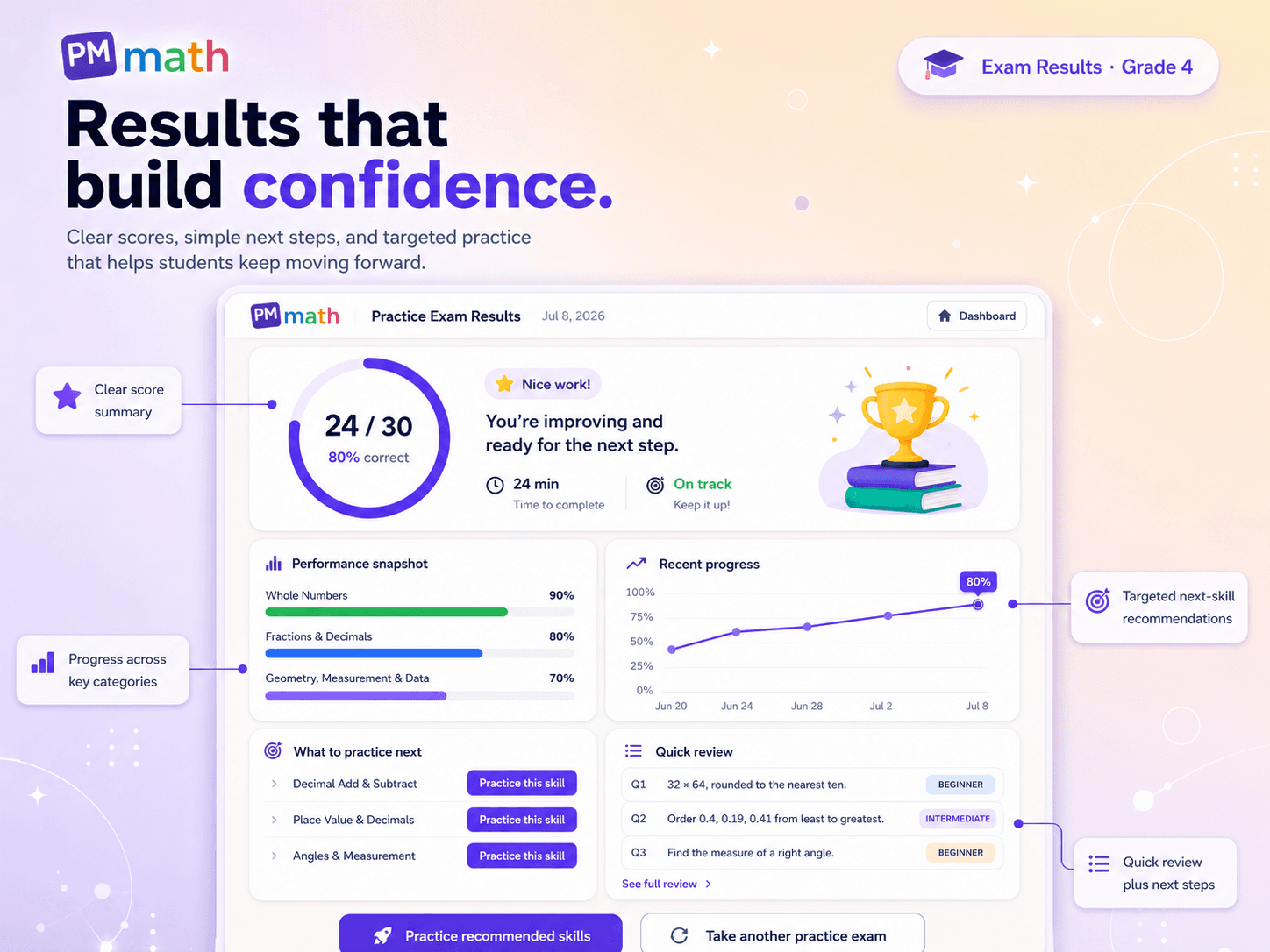
Results that build confidence
Clear scores, progress trends, and targeted recommendations show students exactly what to practice next.
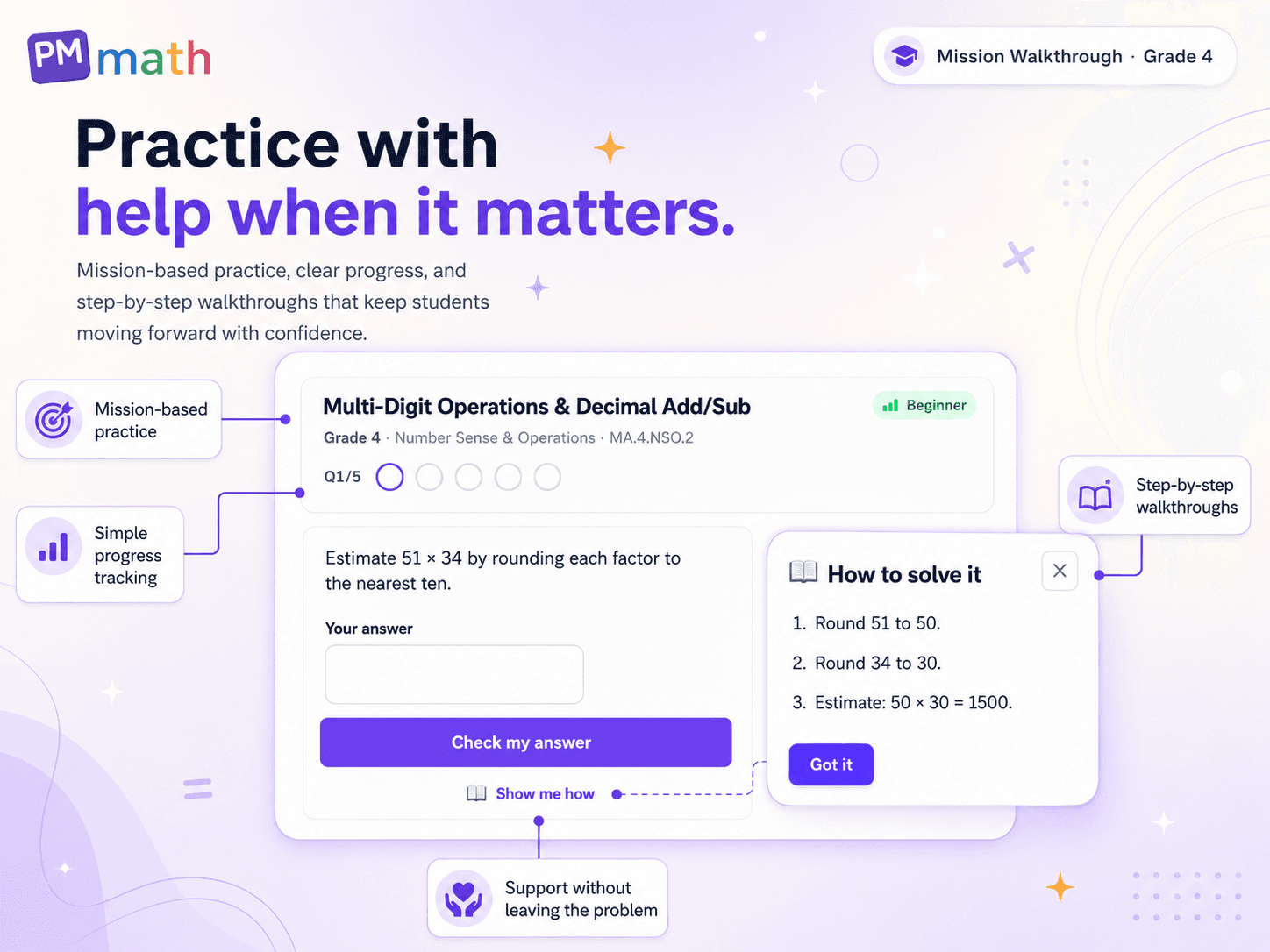
Help when it matters
Step-by-step walkthroughs support students in the moment, and practice gets harder as they improve so they keep stretching toward test-ready skills.
Let your child experience PM Math for themselves.
Explore every grade, practice mission, walkthrough, and exam with a family subscription.
Monthly $7.99 · Annual $79 · Cancel anytime
Grade 1 Florida practice
What first graders work on in PM Math
A Real Grade 1 Example
See what Grade 1 practice looks like
This is a real PM Math Grade 1 measurement question, aligned to Florida B.E.S.T. benchmark MA.1.M.2.1, telling time to the hour and half-hour on analog and digital clocks.
Example Question
What time does the clock show?
Show me how
- The short hour hand points to 4, so the hour is 4.
- The long minute hand points to the 12, which means 00 minutes.
- Write the hour and minutes together as 4:00.
Answer: 4:00
Built for Florida parents
See which Grade 1 skills need practice
Mission Score tracking by strand shows whether gaps are in place value, addition and subtraction, measurement, fractions, or another area.
Build skills throughout the school year
Daily missions and benchmark practice keep first-grade Florida math skills growing from fall through spring, not only around progress-monitoring windows.
Practice Florida-specific standards
Every question maps to a specific Grade 1 Florida B.E.S.T. benchmark (MA.1.*), so practice matches what first graders are expected to learn.
Help your child gain confidence
Age-appropriate visuals, Listen support, walkthroughs, and awards make practice approachable while parents can view progress over time.
Florida B.E.S.T. curriculum
Built around what Florida first graders learn
Florida's B.E.S.T. Standards for Grade 1 math are organized into six strands. PM Math offers practice across all six for Grade 1.
Number Sense and Operations
Counting to 120, reading and writing numbers to 100, place value with tens and ones, addition and subtraction within 20, and exploring addition and subtraction with two-digit and one-digit numbers.
- Count forward & backward to 120
- Tens and ones place value
- Add & subtract within 20
Algebraic Reasoning
Using properties of addition, solving one-step word problems within 20, and finding unknown numbers in addition and subtraction equations.
- Properties of addition
- One-step word problems
- Equations with unknowns
Fractions
Partitioning circles and rectangles into two or four equal parts and naming halves and fourths.
- Halves and fourths
- Equal parts of shapes
- Partition circles & rectangles
Measurement
Estimating and measuring length, comparing lengths, telling time to the hour and half-hour, and working with coins and bills.
- Measure length (in / cm)
- Time to hour & half-hour
- Coins, cents & bills
Geometric Reasoning
Identifying, comparing, and sorting 2D and 3D figures, sketching shapes from attributes, and composing or decomposing figures.
- Identify & sort figures
- Sketch shapes from attributes
- Compose & decompose 2D shapes
Data Analysis and Probability
Collecting data with tally marks or pictographs, then interpreting charts to find totals and comparisons.
- Tally marks & pictographs
- Read totals & comparisons
- Collect and represent data
Florida FAST Mathematics
What is Florida FAST Math for Grade 1?
Florida first graders participate in FAST Mathematics progress monitoring. For Kindergarten through Grade 2, that program uses Renaissance Star Mathematics during PM1, PM2, and PM3, not the same FAST Mathematics assessment experience used in Grades 3–8.
PM Math is an independent practice tool built around Florida B.E.S.T. Grade 1 standards. It is not affiliated with, endorsed by, or operated by the Florida Department of Education or Renaissance Learning. Students practice the skills those standards describe. They do not take an official Star assessment inside PM Math.
Looking for the broader K–5 overview? Florida B.E.S.T. Math Standards for Grades K–5
Practice by Florida B.E.S.T. Benchmark
Every PM Math question is tagged with the specific Florida B.E.S.T. benchmark it practices, so students can work on an exact Grade 1 skill instead of a whole grade at once.
Benchmark reference
1st Grade Florida B.E.S.T. Math Benchmarks
Exact Florida B.E.S.T. Mathematics benchmark IDs for this grade, grouped by strand (26 benchmarks). Open a strand to browse the full list, useful when a report card or progress note lists a code such as MA.1.NSO.1.1.
NSONumber Sense and Operations9 benchmarks
- MA.1.NSO.1.1
- Count forward and backward within 120 by ones; skip count by 2s to 20 and by 5s to 100.
- MA.1.NSO.1.2
- Read numbers 0–100 in standard, expanded, and word form; write them in standard and expanded form.
- MA.1.NSO.1.3
- Compose and decompose two-digit numbers as tens and ones in multiple ways.
- MA.1.NSO.1.4
- Plot, order, and compare whole numbers up to 100.
- MA.1.NSO.2.1
- Recall addition facts with sums to 10 and related subtraction facts automatically.
- MA.1.NSO.2.2
- Add within 20 and subtract related facts using a reliable method.
- MA.1.NSO.2.3
- Find one more, one less, ten more, and ten less than a two-digit number.
- MA.1.NSO.2.4
- Explore adding a two-digit number and a one-digit number with sums to 100.
- MA.1.NSO.2.5
- Explore subtracting a one-digit number from a two-digit number.
ARAlgebraic Reasoning5 benchmarks
- MA.1.AR.1.1
- Use properties of addition to find a sum of three or more whole numbers within 20.
- MA.1.AR.1.2
- Solve real-world addition and subtraction problems within 20 using objects, drawings, or equations.
- MA.1.AR.2.1
- Restate a subtraction problem as a missing-addend problem.
- MA.1.AR.2.2
- Decide whether addition or subtraction equations are true or false and explain why.
- MA.1.AR.2.3
- Find the unknown number in an addition or subtraction equation within 20 (unknown in any position).
FRFractions1 benchmark
- MA.1.FR.1.1
- Partition circles and rectangles into two or four equal parts and name them as halves or fourths.
MMeasurement5 benchmarks
- MA.1.M.1.1
- Estimate length to the nearest inch and measure to the nearest inch or centimeter.
- MA.1.M.1.2
- Compare and order the lengths of up to three objects using direct or indirect comparison.
- MA.1.M.2.1
- Tell and write time to the hour and half-hour on analog and digital clocks.
- MA.1.M.2.2
- Identify pennies, nickels, dimes, and quarters; use the ¢ symbol; know how many of each equal a dollar.
- MA.1.M.2.3
- Find the value of coin combinations up to $1 and of $1, $5, and $10 bills up to $100.
GRGeometric Reasoning4 benchmarks
- MA.1.GR.1.1
- Identify, compare, and sort 2D and 3D figures by defining attributes.
- MA.1.GR.1.2
- Sketch 2D figures (triangles, rectangles, squares, hexagons) from given attributes.
- MA.1.GR.1.3
- Compose and decompose 2D and 3D figures.
- MA.1.GR.1.4
- Identify parts of a real-world object that can be modeled by 2D or 3D figures.
DPData Analysis and Probability2 benchmarks
- MA.1.DP.1.1
- Collect categorical data and represent it with tally marks or pictographs.
- MA.1.DP.1.2
- Interpret tally charts and pictographs by finding totals and comparing categories.
Grade 1 Florida Math FAQ
- What math should a Florida first grader know?
- Florida's B.E.S.T. Standards for Grade 1 cover six strands: Number Sense and Operations, Algebraic Reasoning, Fractions, Measurement, Geometric Reasoning, and Data Analysis and Probability. See "Built around what Florida first graders learn" above for specifics.
- Does 1st grade take Florida FAST Math?
- Yes. Grade 1 participates in Florida FAST Mathematics progress monitoring. For Kindergarten through Grade 2, FAST Mathematics is administered using Renaissance Star Mathematics during PM1, PM2, and PM3, not the same Grades 3–8 FAST Mathematics testing experience.
- What is Star Mathematics for 1st grade?
- Star Mathematics is the Renaissance tool Florida uses for K–2 FAST Mathematics progress monitoring. PM Math practices Florida B.E.S.T. Grade 1 skills independently. It is not affiliated with or endorsed by Renaissance Learning, and it does not claim to be the official Star assessment.
- Is PM Math aligned with Grade 1 Florida B.E.S.T. Standards?
- Yes. Every PM Math Grade 1 question and benchmark is mapped directly to the Florida B.E.S.T. Mathematics Standards (MA.1.* for Grade 1).
- Can my child practice individual Grade 1 benchmarks?
- Yes. After creating an account, you can choose a specific Florida B.E.S.T. benchmark, like MA.1.M.2.1 (tell time to the hour and half-hour), for your child to practice, in addition to recommended daily missions.
- Does PM Math include Grade 1 practice exams?
- Yes. Grade 1 students can take mixed-skill PM Math practice checks: an 18-question half exam or a 34-question full practice exam, with a score report and review afterward. These are PM Math practice checks, not official Star Mathematics tests.
Ready to give your first grader focused Florida math practice?
Give your first grader Florida B.E.S.T.-aligned practice that adapts, explains mistakes, and builds skills through the year.
Subscribe to PM MathMonthly $7.99 · Annual $79 · Cancel anytime
Have a student in another grade? See PM Math for grades K–5 · Kindergarten guide · Grade 2 guide